

WHAT IS AIR POLLUTION?
Air pollution is the presence of irritant contaminants in the air such as dust, exhaust fumes, gas, chemical mist, odour, smoke and other fine particles, in quantities and duration that can be injurious to human health. Common pollutant gases include carbon monoxide (CO), ozone (O3), nitrogen dioxide (NO2) and sulphur dioxide (SO2).
Exposure occurs through our respiratory tract through the nose, mouth and even the eyes. Breathing in these pollutants leads to inflammation, damage, stress, lowered immunity, and even genetic mutations in our body cells, affecting the airway, lungs, blood vessels, heart, and ultimately multiple organs including the brain.
WHAT ARE THE TYPES OF AIR POLLUTION?
Air pollution may be:
- Ambient air pollution– Pollution in the outdoor atmosphere, originating from a wide range of environmental sources like vehicle exhaust, industrial emissions, fires, sandstorms, and natural sources like dust and pollen.
- Home (indoor) air pollution– Pollution that occurs inside homes, often at higher concentrations than outdoor levels, from household fuel combustion, cooking with gas, cleaning products, furniture and paints, tobacco smoke, volatile organic compounds (VOCs), carbon monoxide, formaldehyde, pet dander, dust mites, and mold.
PM2.5
PM stands for particulate matter (also called particle pollution) is the term for a mixture of solid particles and liquid droplets found in the air. PM2.5 pollution refers to fine microscopic particulate matter less than 2.5 microns in diameter, which due to their small size, are inhaled deep into the lungs and able to enter the bloodstream to circulate throughout the entire body leading to inflammation and sometimes increased risk of cancer.
Sources include vehicle exhaust, industrial emissions, power plants, and burning wood, crops, forest, landfills, or waste. Health problems linked to PM2.5 include respiratory and cardiovascular diseases, and even premature death.
All particulate matter less than 10microns can enter our airway and cause damage. However, PM 2.5-10 microns (PM10) which is coarse PM from sources like wind-blown dust, industrial operations, and agriculture, primarily affects the upper respiratory system and is largely filtered by nasal passages and throat.
WHAT ARE THE DISEASES CAUSED OR AGGARAVATED BY AIR POLLUTION?
These include an increased risk of:
- asthma attacks
- bronchitis and chronic obstructive pulmonary disease (COPD)
- pneumonia
- cough and cold
- lung cancer
- eye irritation
- headaches
- stress
- cardiovascular disease
- stroke
- reduced life span
There is suggestive evidence also linking air pollution exposure to risk for adverse pregnancy outcomes (like low-birth weight, small for gestational age), as well as increasing risk of diabetes, cognitive impairment and neurological diseases.
WHAT IS AQI?
AQI, or Air Quality Index, is a numerical scale that measures how polluted the air is and how it impacts health over a short period. It is calculated based on pollutants like ground-level ozone, particle pollution (PM2.5, PM10), carbon monoxide, sulfur dioxide, and nitrogen dioxide. The index ranges from 0 to 500, and as the AQI increases, the potential for adverse health effects also increases (at higher AQI, older adults, children, and people with heart or lung diseases may experience greater health risks, and eventually, all people can be affected).
The concentration of each pollutant is converted into a sub-index using a specific formula and the corresponding health breakpoints. The AQI is divided into 6 color coded categories, that correspond to different levels of health risk (e.g., Good, Moderate, Poor, Very Poor, Severe, Hazardous).
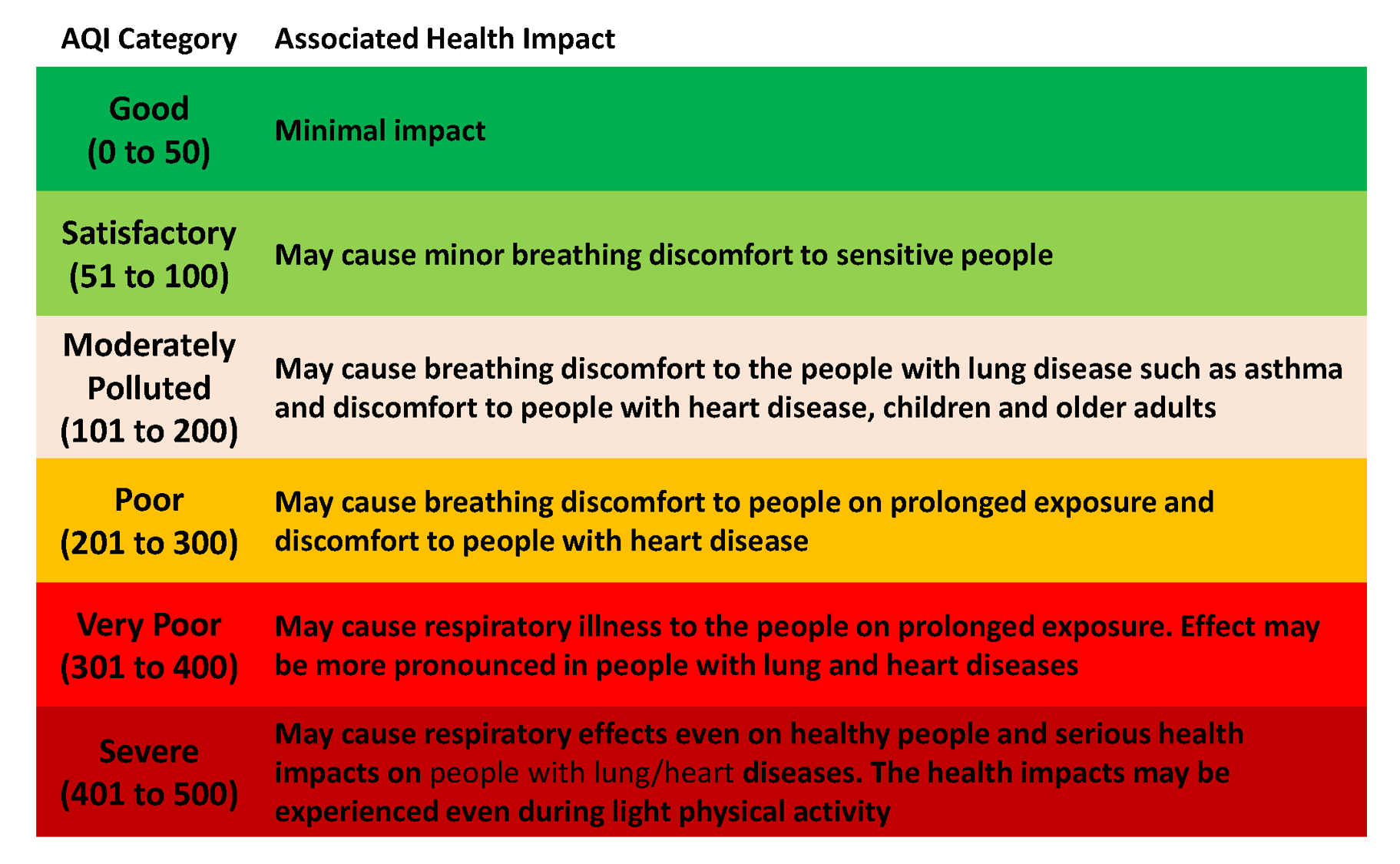
There are also some calculating apps and formulae for expressing AQI as number of cigarettes smoked/day, but these give a rough idea only and are quantitative not qualitative. The increase is exponential (AQI 100, 200 and >500: Roughly equivalent to smoking 1, 4-5, and 25-30 cigarettes/day respectively).
HOW TO CONTROL AND PROTECT ONESELF
To control air pollution, it has to be a collective effort at individual, community and state/national level.
Here are some ways that need to be implemented –
Reducing Transportation Exhaust
- improving public transport – CNG (compressed natural gas) buses, cabs and metro or electric trains
- monitoring private vehicles – car pools, odd-even car days, regular pollution under controlcertificate checks for vehicles, fining high exhaust vehicles, and rewarding the use of electric vehicles (EV)
- encouraging healthy transportation – walking, biking, and combining errands, and avoiding excessive vehicle use for short distances.
Energy consumption at home: Using efficient appliances, turning off lights and electronics when not in use, and using fans instead of air conditioners when possible.
Industrial and commercial: Factories should install and maintain pollution control devices like scrubbers, electrostatic precipitators, and filters to capture or transform pollutants.
Agricultural: To stop pollution from crop burning, farmers can use in-situ methods like bio-decomposers or machines, out-of-situ methods by converting crop residue into products like biomass pellets, animal feed, or materials for paper and boards, and promoting crop diversification and climate-smart techniques like ‘no-till’ farming.
Waste management: Not burning garbage or crop waste, and introducing structured waste disposal methods in society along with recycling techniques as much as possible.
Energy sources: Investing in and promoting renewable energy sources like solar and wind power, and other cleaner fuels.
Policy and enforcement: Governments can enforce strict emission standards for vehicles and industries, monitor air quality, and support clean energy initiatives.
Green spaces: Increase green cover by planting trees and vegetation, which can help filter pollutants and cool the environment.
Increasing Awareness: Medical and health professionals giving talks on health concerns of pollution as well as smoking, staying informed about air quality, and encouraging student participation in clean air initiatives.
Protective measures against air pollution –
- Use a HEPA-filter air purifier in rooms at home and offices.
- Prevent outdoor pollutants from entering your home if AQI is high by closing windows. Open windows only when outdoor air quality is better, typically in the afternoon, if possible.
- Some indoor plants, like Snake Plant, Peace Lily, Spider Plant, Areca Palm, and English Ivy, are effective at removing pollutants like formaldehyde, benzene, and xylene from the air. Other options are Aloe Vera and Rubber Plant, which also help filter pollutants and can increase humidity, improving indoor air quality.
- Wipe surfaces with a damp cloth to reduce dust.
- Use an N95 or N99 mask to filter out fine particles when outside.
- Stay inside as much as possible, especially during peak pollution hours (often mornings and evenings). When outside, stay away from busy roads and highways where pollution is concentrated.
- Run car AC in the “re-circulate” mode to reduce indoor pollution, and ventilate it by opening windows briefly before turning the AC on.
- Shower or bathe to rinse pollutants from your skin and hair after returning home.
- Avoid exercising outdoors in high-pollution areas; move to a gym or do exercises indoors instead. Swimming can be a good outdoor exercise option.
- Maintain a healthy diet by eating foods rich in antioxidants like nuts, fruits and vegetables. Drink plenty of water to remain hydrated and help your body flush out harmful particles.
- If having any health condition especially respiratory or cardiac issues, take medicines regularly and if experiencing symptoms like shortness of breath or cough, consult a doctor as soon as possible.
Also read: