

Autoinflammatory diseases are rare disorders caused by a dysfunctional innate immune system, leading to recurrent or chronic inflammation without the involvement of the adaptive immune system.
The immune response consists of 2 components:
- a) innate immunity that is immediate, non-specific, and without memory, initiated by white blood cells like neutrophils and macrophages.
- b) adaptive immunity, a longer, specific response through T-lymphocytes and antibodies, that has memory.
Autoimmune and autoinflammatory diseases are both caused by the immune system mistakenly attacking the body, but they originate from different parts of the immune system. Autoimmune diseases involve the adaptive immune system (antibodies and T-cells), whereas autoinflammatory diseases involve the innate immune system (macrophages and neutrophils). Autoimmunity and autoinflammation can be either of monogenic inheritance (rarer and involves a single gene) or polygenic inheritance involving multiple genes, often with environmental influence, creating a spectrum with continuous variation.
Autoimmune and autoinflammatory diseases can have an overlap based on immune responses, and they are part of a continuous spectrum. Some polygenic forms of arthritis, spondylitis, vasculitis, psoriasis, uveitis, and inflammatory bowel disease (IBD) may represent such overlap.
Read: Understanding Immunity
Autoinflammatory diseases consist of symptoms including recurring fevers (usually high, a hallmark symptom), skin rashes, mouth sores, and pain in joints or other organs like those of the abdomen. They are often caused by gene mutations that trigger an overactive innate immune response, and diagnosis can be delayed because the symptoms may be non-specific and mimic other conditions.
MONOGENIC
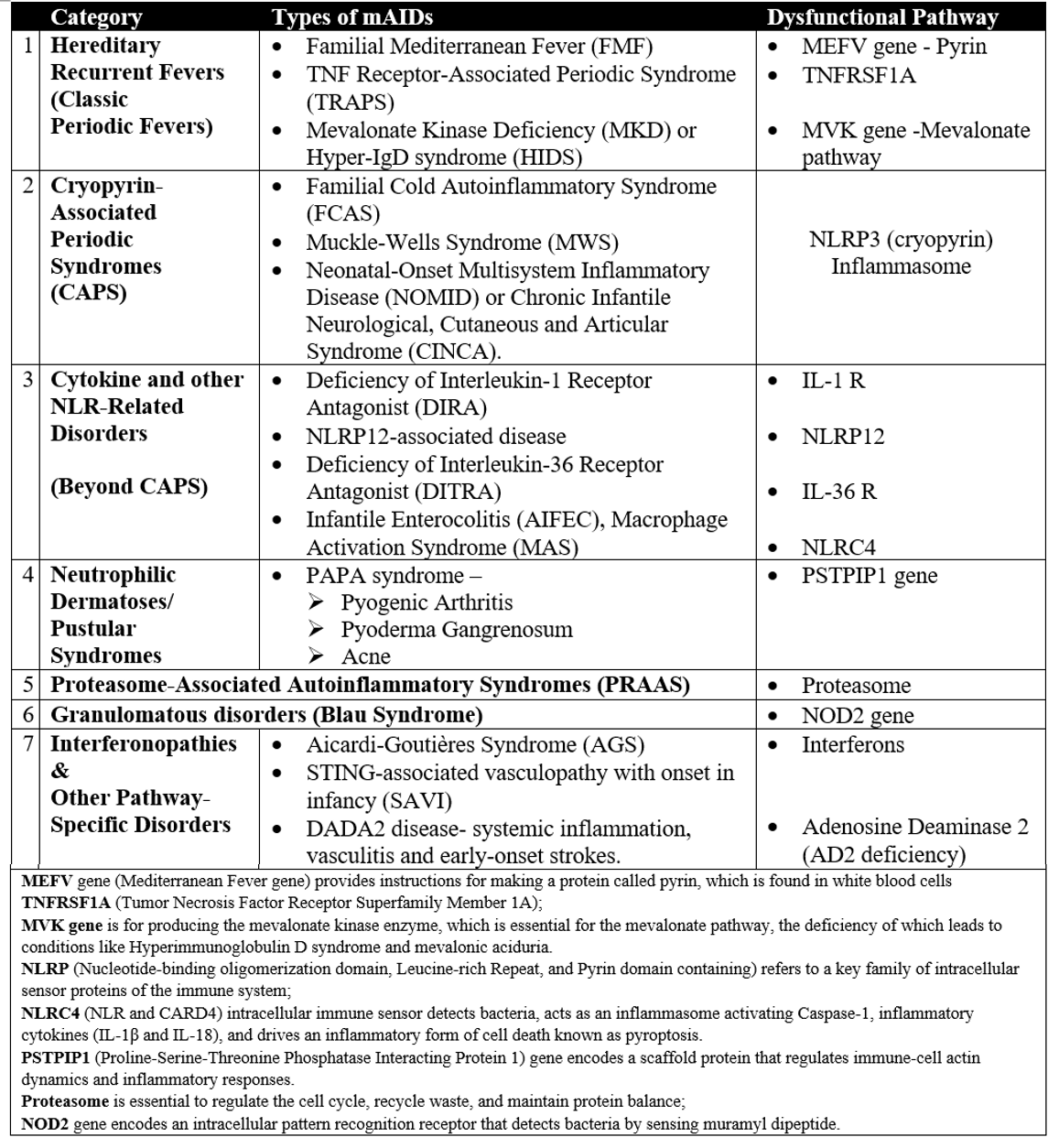
Monogenic Autoinflammatory Diseases (mAIDs) are very rare and can be broadly categorized into several groups based on their clinical presentation and underlying genetic defects or dysfunctional pathways, as shown in the table.
Symptoms of mAIDs can include:
- recurring, unprovoked fevers that can last from a few days to a few weeks
- skin rashes or hive-like (urticarial) plaques
- joint swelling and pain (arthralgia/arthritis)
- severe localized muscle pain (myalgia)
- severe abdominal pain, vomiting, and diarrhea
- painful conjunctivitis (pink eye), uveitis
- sensorineural hearing loss.
- swollen lymph nodes (lymphadenopathy)
- enlargement of the spleen or liver
Diagnosis of mAIDs is mainly by Genetic Testing, with Molecular genetic testing being the gold standard for confirming a mAID diagnosis by analysing specific candidate genes (such as MEFV, TNFRSF1A, MVK, or NLRP3) associated with classic periodic fever syndromes. Supportive tests include blood tests during flares (CBC, ESR, CRP) and serum amyloid A (SAA).
Treatment of mAIDs is with monoclonal antibody drugs and biologicals (like IL-1 inhibitors, anti-TNF drugs), JAK inhibitors, Colchicine, and NSAIDs as supportive medicines.
POLYGENIC
The most well-known polygenic autoinflammatory diseases are Gout and Pseudogout. Others include Sarcoidosis, Still’s Disease, and some other rare conditions. As mentioned, sometimes conditions like IBD, psoriatic arthritis, some large vessel arteritis (vasculitis), and idiopathic uveitis are also considered in this category, or grouped under autoimmune or related conditions by others.
GOUT AND PSEUDOGOUT
Gout is considered a polygenic auto-inflammatory disease where the innate immune system responds excessively to uric acid (monosodium urate – MSU) crystals. Gout mainly manifests as a joint disease (urate crystals deposit in joints, triggering autoinflammation).
Pseudogout is similar clinically to gout, but the crystals are those of calcium pyrophosphate dihydrate (CPPD) in the cartilage, not uric acid. Risk factors include age>60 years, associated metabolic conditions (hyperparathyroidism, hemochromatosis – iron overload, hypothyroidism, or low magnesium), or joint trauma or surgery.
While both gout and pseudogout manifest similarly as pain and inflammation of joints, gout tends to affect small joints like toes and fingers, while pseudogout affects the knee, or the elbow and wrist more.
Read: GOUT AND PSEUDOGOUT
OTHER POLYGENIC AUTOINFLAMMATORY CONDITIONS
Sarcoidosis is a condition that leads to inflammation (in the form of grain-like lumps called granulomas), usually in the lungs, skin, or lymph nodes, but can affect any organ. It may be asymptomatic in some or present with symptoms like cough, shortness of breath, weight loss, night sweats, and fatigue. Diagnostic tests include a chest x-ray, lung function tests, and a biopsy. Corticosteroids or immunosuppressants are used in significantly symptomatic or severe cases.
Still’s Disease is a rare autoinflammatory disorder characterized by a classic triad of high spiking daily fevers, severe joint pain, and an evanescent salmon-pink rash. It affects both children (systemic Juvenile Idiopathic Arthritis – sJIA) and adults (Adult-Onset Still’s Disease -AOSD) and is managed primarily by rheumatologists using immunosuppressive and biologic medications.
Behçet’s disease is a rare, chronic inflammatory vasculitis affecting vessels throughout the body, leading to painful sores (mouth, genital), eye inflammation (uveitis), skin rashes/nodules, arthritis, and potentially severe problems in the brain, gut, or major vessels.
PFAPA Syndrome (Periodic Fever, Aphthous stomatitis, Pharyngitis, and Adenitis) predominantly affects young children, causing recurring bouts of fever and swollen lymph nodes.
Chronic Recurrent Multifocal Osteomyelitis (CRMO), also known as Chronic Non-Bacterial Osteomyelitis (CNBO), causes sterile, painful inflammation in the bones.
Schnitzler syndrome is a rare, acquired autoinflammatory disorder typically emerging in middle age, characterized by a chronic, hive-like rash and raised IgM antibodies. Symptoms include recurrent fevers, bone/joint pain, and swollen lymph nodes.
Other very rare conditions are Sweet’s Syndrome (acute febrile neutrophilic dermatosis) and Idiopathic Recurrent Pericarditis
Also read:
Autoimmune Diseases: 15 Well-Known Types and Medical Management