

WHAT IS PARKINSON’S DISEASE
Parkinson’s disease is a result of degeneration (deterioration or slow damage to the nervous system) and a decrease in a chemical called dopamine. It is usually seen after the age of 50 years, but there are some young-onset variants. Early symptoms like tiredness, sleeping problems, constipation, or even a loss of smell may go unnoticed till the tremor comes on.
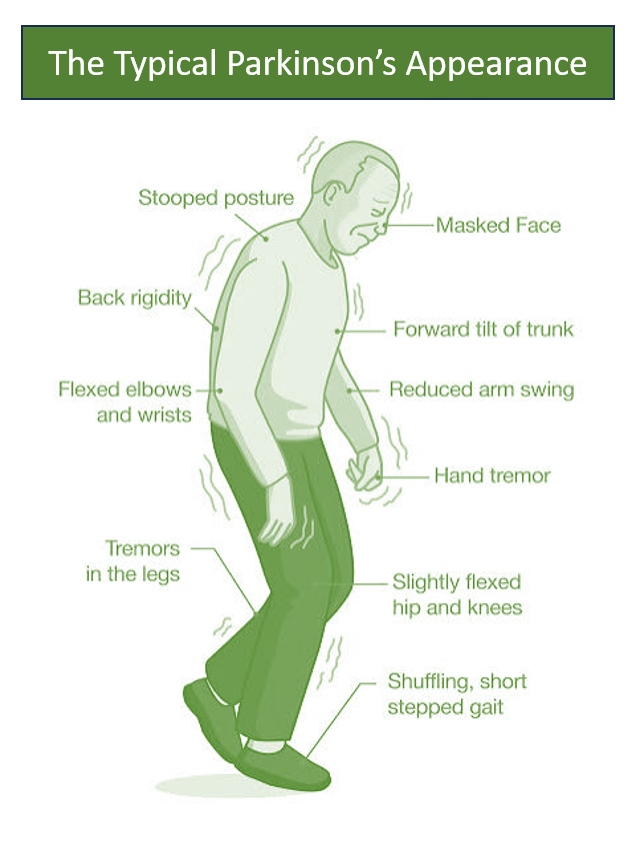
Apart from tremor, other symptoms of Parkinson’s include slowing down and difficulty with some movements like swinging one’s arms, getting out of bed, taking long walking strides, and turning around, which may result in moving with slow, small steps and episodes of losing balance. Also, the characteristic is the reduction in facial expressions and blinking.
Gradually, mental faculties deteriorate, such as memory, grasping power, and reasoning, leading to confusion and forgetfulness. There may be accompanying anxiety-depression. A change in handwriting (becomes small and cramped) is characteristic of disease progression.
Advanced cases may show physical problems like drooling, difficulty in swallowing and speaking, sweating, difficulty in passing stool/urine, or inability to have an erection. As muscle weakness and stiffness slowly set in all over the body, one may be unable to stand, have pain and require assistance in moving and in many daily activities.
The classic Parkinson’s tremor, if some of the above symptoms co-present themselves, the diagnosis is pretty obvious, and usually, medicines that increase the neurochemical dopamine and its action are administered as treatment. However, if only a tremor is seen without the other mentioned symptoms, sometimes it may be hard to be sure of the cause.
The Parkinson’s Tremor…..
Tremor is a sign in almost 80% of Parkinson’s cases and has some features that set it apart-
- Usually starts on one side and then may go on to the other side.
- Though the hand is the most common, well-known, and visible tremor site, Parkinsonian tremors can also occur in the legs, feet, jaw, chin, mouth, or tongue
- Tremors of the head and voice are rare.
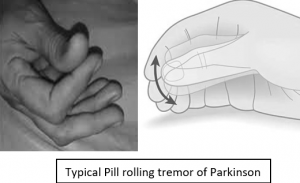
- Parkinson’s tremor has a rolling typicality where the thumb rolls something on the other fingers.
- A typical Parkinson’s tremor occurs at rest (when not doing any activity).
- The tremor disappears with movement and comes back on holding something for a long time, like a spoon, etc.
- Apart from having social repercussions, the tremor itself usually does not interfere with daily activities.
MANAGEMENT
Parkinson’s disease can’t be cured, but can be controlled with medications and lifestyle measures like controlled and guided physical exercise therapy to improve balance and coordination, a nutritious diet, psychological counseling, and speech therapy.
Medicines include drugs that increase dopamine levels and action. The first line and most effective drug is levodopa-carbidopa (oral combination drug Syndopa). With time and disease progression, the drug’s effect may decrease, and an increase in drug doses may produce involuntary movements called dyskinesia, thereby necessitating dose reduction and modification. Recently, an inhaled form of this drug has been made available, which can reduce some of the side effects seen with the oral pills.
Duodopa is a gel form of levodopa-carbidopa for continuous intestinal administration with a portable pump directly into the duodenum or upper jejunum by a permanent tube via a procedure called percutaneous endoscopic gastrostomy.
In more advanced cases, this drug can also be given as a gel infusion through a feeding tube. A medicine called foslevodopa-foscarbidopa (also called Produodopa) has been approved to treat people with Parkinson’s who experience movement-related symptoms. Produodopa is given over 24 hours by a small pump that delivers a continuous dose of the medication from a syringe. This steady delivery helps maintain consistent dopamine levels, reducing the fluctuations in symptoms that patients often experience with other treatments.
A drug called amantadine is sometimes given to provide quick relief of symptoms in the early stages, or with levodopa-carbidopa therapy during the later stages of Parkinson’s disease to reduce dyskinesia. Anticholinergic medications (like benztropine, trihexyphenidyl) are given mainly to reduce Parkinson’s tremors.
Other drugs include dopamine mimics (agonists) like pramipexole and ropinirole (oral), rotigotine (given as a patch), and apomorphine (short-acting injection or sublingual films).
Sometimes a class of drugs called MAO-B inhibitors (selegiline, rasagiline) is prescribed. These two groups of drugs are not as effective as carbidopa-levodopa, and can have psychotic side effects. They are only used as reserve medicines for the waning effects of carbidopa-levodopa.
Another class of reserve drugs is the COMT inhibitors (entacapone, tolcapone) that are to be used only along with levodopa-carbidopa when its effect is wearing off. However, these drugs can worsen dyskinesias.
In advanced and non-responsive cases, a procedure called deep brain stimulation (DBS) is performed and has been seen to be effective in sustained relief.
Note – It is important to differentiate the tremor of Parkinson’s disease from Benign Essential Tremor and other causes.
Also read:
Dementia and Alzheimer’s Disease – Awareness, Understanding and Solutions