

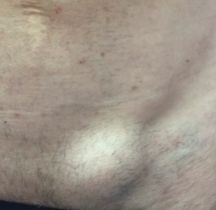
HOW AND WHY DOES A HERNIA OCCUR
A hernia occurs when part of an internal organ or fat pushes through a weak spot or opening in the surrounding muscles or covering tissues (connective tissue or fascia).
The weak spot can develop as a result of an anatomical defect, persistent increase in abdominal pressure (chronic severe constipation, lifting heavy weights improperly, chronic cough), surgery in that particular area, or during pregnancy when the abdominal wall stretches. Hernias often happen in the groin or abdominal (belly) wall that are relatively weaker.
Hernias present as a bulge or lump. The bulge becomes more prominent when abdominal pressure increases, as during straining for stool, and coughing or sneezing.
Rarely, one may be born with a hernia (congenital hernia), especially seen in premature birth, certain conditions (cystic fibrosis, connective tissue disorders, abnormal hip development, or some urinary or reproductive tract problems like undescended testicles).
TYPES
In a reducible hernia, the lump can be pushed back through the belly/groin wall, which when not possible it is called an irreducible, which is more likely to have complications. In an incarcerated hernia, part of the organ (such as the bowel) that has protruded through gets stuck there. This can create severe pain and other symptoms like nausea, vomiting, and constipation. If the blood supply gets cut off due to incarceration, the hernia becomes strangulated, and the bowel tissue starts to die, and emergency surgery is needed.
The most common types of hernias are inguinal (inner groin), femoral (outer groin), umbilical (belly button or navel), incisional (resulting from a surgical cut), and hiatal (upper stomach).
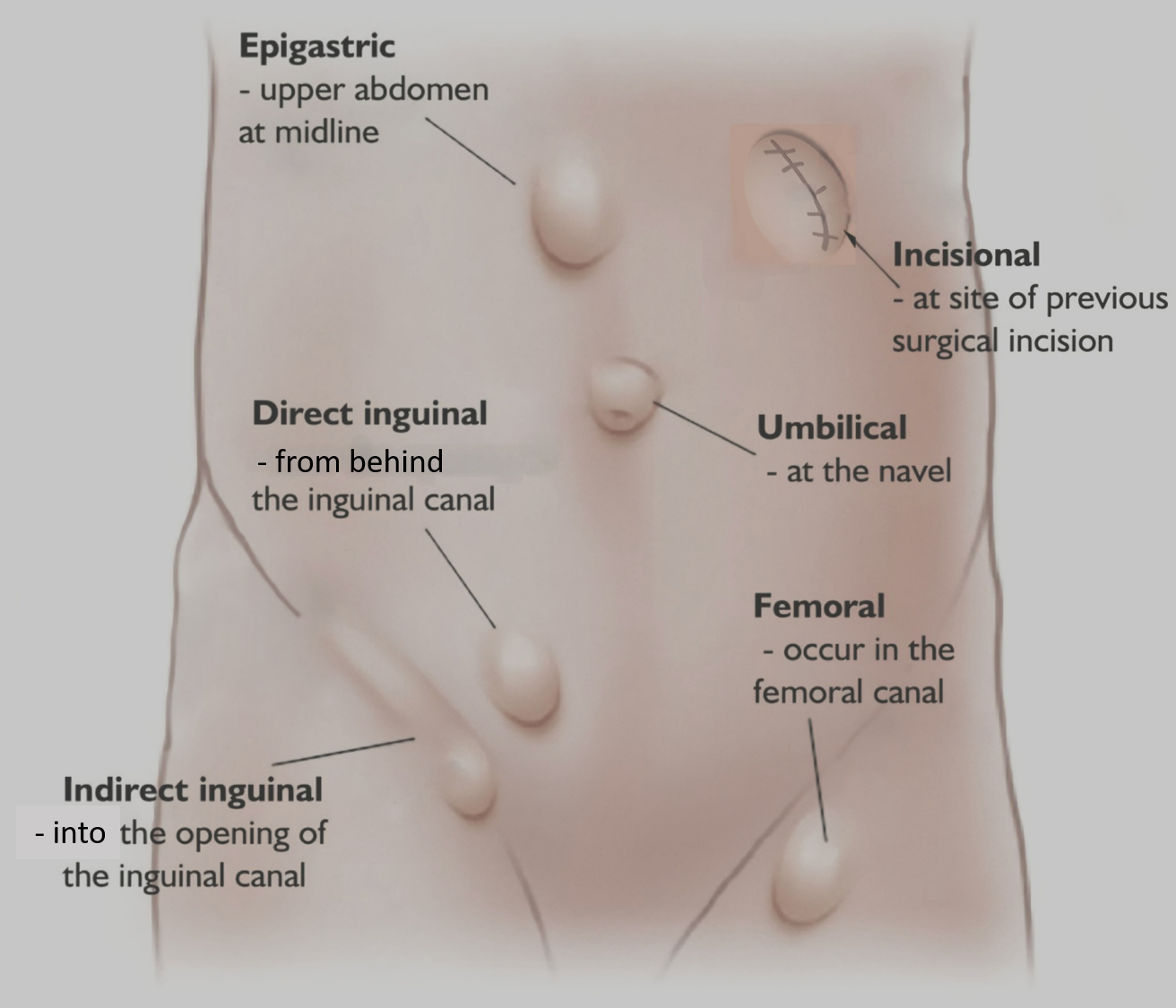
Inguinal hernia
The inguinal hernia is the most common type of hernia, accounting for roughly 75% of all cases, overall, and is seen more frequently in men.
It occurs when part of the intestine pushes through a weakness in the lower abdomen, causing a bulge in an area of the groin called the inguinal canal (an oblique, 4- 6 cm long passage in the lower front abdominal wall on either side). In males, this canal contains the ductus deferens (tube that transports mature sperm from the epididymis above the testis to the ejaculatory duct), testicular blood vessels, and nerves, while in females it contains a ligament connecting the uterus (round ligament) and some nerves.
There are two kinds of inguinal hernia:
-
- Indirect. The intestinal or abdominal parts enter the inguinal canal through its opening (the deep inguinal ring) and can travel all the way down into the scrotum (in males) or labia majora (in females). It is the most common type of inguinal hernia overall (about 80% of cases) and is seen in infants, children, and younger males.
- Direct. The abdominal contents protrude through a weakness in the back wall of the inguinal canal. It happens due to muscle weakening with older age, heavy lifting, or chronic straining (such as coughing or constipation).
The lump is seen where the thigh and groin meet. The bulge reduces or disappears when lying down, but reappears if one coughs, stands, or strains. The bulge can be accompanied by a heavy feeling, pressure, or weakness in the groin or lower abdomen, constipation, discomfort in the abdomen or groin when lifting or bending over, and sometimes a burning or aching sensation at the bulge. Pain and swelling around the testicles may be seen in the indirect inguinal type.
Femoral hernia
Femoral hernias account for only a few out of every 100 hernias, but are more frequent in women (accounting for roughly 20-30% of hernia repairs in women). They’re more common in older women and are often mistaken for inguinal hernias. The lump or bulge is in a different area of the groin called the femoral canal, right beneath the inguinal canal, along the crease of the groin or just into the upper thigh. This canal contains loose connective tissue, fat, deep lymphatic vessels, and the highest deep inguinal lymph node. Femoral hernia is more likely to get stuck than inguinal hernias.
Umbilical hernia
About 15% of babies, especially those born prematurely, have a congenital hernia, usually umbilical, that occurs when fat or part of the intestine pushes through the muscle near the belly button or navel. Among adults, women are more likely than men to get an umbilical hernia. Risk factors include being overweight, multiple pregnancies, chronic cough or constipation, repeated or frequent vomiting episodes, or fluid in the abdomen (ascites). Men who have trouble passing urine because of an enlarged prostate are also at risk. Increased pressure in the abdomen or belly area seen in these conditions pushes the hernia out.
Incisional hernia
Around 10% of hernias are incisional and form where there is the cut from a previous surgery. The surgery might have weakened the abdominal wall muscles, making them vulnerable to tearing and creating a weak spot.
Incisional hernias are common in people who have especially had emergency surgery, or those who gained significant weight, did heavy exercise, or got pregnant before the surgery incision healed completely. Elderly or obese people, smokers or those with a chronic lung disease, those with diabetes or kidney disease, and people on long-term medications like steroids or immunosuppressants are at higher risk.
Epigastric hernia
Less than 4% of abdominal hernias are epigastric. They’re more common in men aged 20-50. It forms at the midpoint between the sternum (breastbone) and belly button (navel), due to fat pushing through a weakness in the abdominal wall muscles, causing a painful bulge.
Hiatal hernia
About 20% of people get a hiatal hernia, half of whom are over 50 years. This is also the most common type of hernia among pregnant people. Unlike other hernia types, a hiatal hernia affects the diaphragm (the muscle that separates the chest from the belly) and not the abdominal wall, so is not seen as an external bulge. The food pipe (esophagus) passes into the stomach through an opening in the diaphragm. In a hiatal hernia, part of the stomach bulges up through this opening into the chest. It can cause heartburn, sour taste in the mouth, nausea and vomiting, difficulty in swallowing, or chest pain.
Congenital Diaphragmatic Hernia is a rare, dangerous type of hernia (affects 1 in 2,500 babies) that occurs due to a birth defect in the diaphragm through which he baby’s still-growing organs can slip through and put pressure on the lungs.
Spigelian hernia
This kind of hernia is rare, making up less than 2% of all abdominal wall hernias, most common in women and people over 60 years. It forms when abdominal tissue pushes through a weak area of connective tissue called the Spigelian fascia just to each side of the 2 midline abdominal strap muscles. Usually, a lump is not seen and these hernias are particularly likely to get stuck (incarcerated).
Perineal hernia
The pelvic floor is a funnel-shaped sheet of muscles and connective tissue that separates the pelvic cavity (containing the bladder, uterus/prostate, and bowels) from the perineum (area between the external genitals and anus). A perineal hernia is extremely rare and occurs when a weak or damaged pelvic floor allows internal organs (such as fat, part of the intestine, rectum, or the urinary bladder) to bulge into the perineum. This can be caused by open radical pelvic surgery, injury, or pregnancy. It can present as pain or discomfort when sitting, and a feeling of heaviness or noticeable bulge in the perineal or gluteal area.
MANAGEMENT OF HERNIAS
Most bulging hernias can be diagnosed by medical observation and examination. Occasionally, a CT scan or other imaging tests may be needed. Hernia does not heal on its own, and most will eventually require surgical repair and monitoring.
If a hernia is very small, causes no pain, is reducible, and does not interfere with daily activities, doctors may recommend monitoring the hernia over time, rather than operating right away. The doctor may suggest wearing a corset, binder, or truss, as supportive undergarments that apply gentle pressure on the hernia and keep it in place, and may also ease discomfort or pain. They also serve as temporary relief before surgery. Many hiatal hernias do not cause symptoms, so they may not require surgery. Umbilical hernias in babies and young children often close on their own by the age of 4 or 5 years without surgery.
Surgery Is Recommended for:
- Hernia causing pain, or difficulty with normal activities.
- Hernia that is enlarging over time.
- Femoral hernia (due to a high risk of complications)
- Adult umbilical hernia
- Irreducible hernias for preventing incarceration and strangulation
A hernia needs emergency surgery if it becomes strangulated or obstructed. Red flag signs include:
- Sudden, severe pain or tenderness at the hernia site
- Nausea or vomiting
- Inability to pass gas or stools
- Bulge looks red, purple, or dark
- Bulge feels numb
- Fever
Surgeries for hernias can be keyhole (laparoscopic) or open, done at a hospital under anesthesia. Today, minimally invasive robotic surgery is also available. The surgery helps close the weak area of the muscle from where the hernia pushed through with stitches, and adds a piece of flexible mesh for extra support. Nissen fundoplication for hiatal hernia involves stitching together the upper stomach and lower esophagus.
This type of operation is normally very safe. Rarely, there may be issues like infection, clots, mild-to-moderate postoperative pain, or temporary difficulty in passing urine.
Most people can get up and move around within a few days of surgery. Over time, one can slowly raise activity levels and return to work in 1-2 weeks, depending on the kind of job. After a month or so, one can resume more intense activities, like lifting heavy objects.
Also read:
How Long Does Hernia Surgery Take? Procedure Times and What to Expect
Constipation – Multifactorial Problem Needing Multifaceted Health solutions
Vomiting and Nausea – Understanding Causes, Alert Signs and Health Measures