

Gout and Pseudogout are polygenic autoinflammatory diseases and are called Crystal Induced Arthritis (CIA).
Read: Autoinflammatory Diseases
WHAT IS GOUT
It is an auto-inflammatory disease where the innate immune system responds excessively to uric acid (monosodium urate – MSU) crystals. Gout mainly manifests as a joint disease (urate crystals deposit in joints, triggering autoinflammation).
Risk factors include high uric acid levels, due to:
- diet (red meat, seafood, sugary drinks, alcohol)
- genetics
- being elderly (more in men)
- obesity
- certain medications
- associated health issues like high blood pressure, kidney disease, and diabetes
- joint surgery or trauma
WHAT ARE THE SYMPTOMS?
Gout manifests as flares that typically peak within 8 to 12 hours and subside within 1 to 2 weeks. Between flares, one usually experiences no symptoms, but repeated flares or untreated gout can lead to chronic complications, kidney stones, and compromised kidney function.
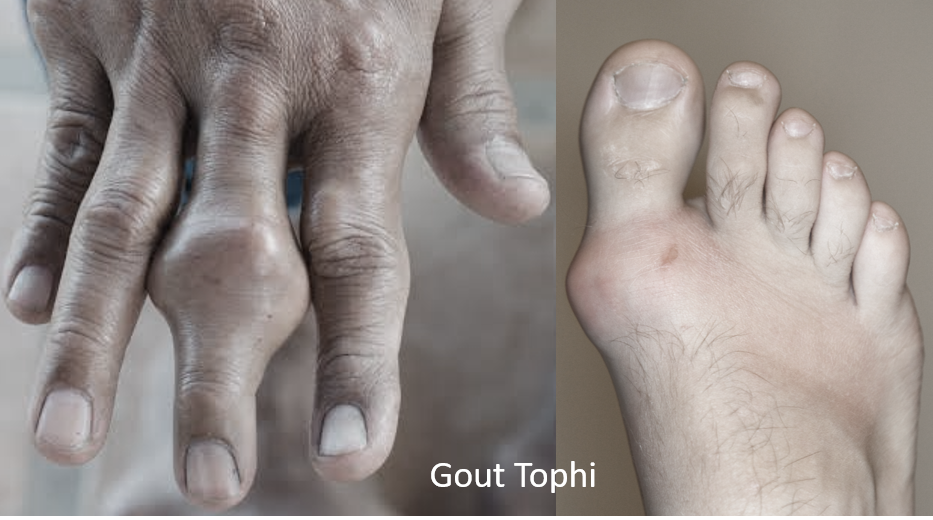
Gout symptoms include sudden, severe joint pain, intense tenderness, swelling, redness, and a hot or warm sensation in the joint. Tophi are painless, hard, chalky-white lumps of uric acid crystals that form under the skin around joints or in soft tissues. This leads to chronic stiffness and a limited range of motion in affected joints.
Gout most commonly affects the big toe, or the smaller joints of toes and fingers, but can also strike the ankles, knees, wrists, and elbows.
GOUT AND HIGH URIC ACID
Gout is almost uniformly associated with high uric acid (hyperuricemia) as the uric acid (urate) crystal formation occurs when serum uric acid levels are elevated past their solubility threshold (typically around 6.8-7 mg/dL). However, the reverse is not true, as many people with high uric acid never develop crystals or gout symptoms.
While high uric acid is a prerequisite, it is entirely possible to experience an acute gout flare at normal blood uric acid levels, as the attacks are triggered by existing uric acid crystals deposited in the joints due to the innate immune response, regardless of the current blood uric acid levels. Sometimes during an acute flare, the body often pulls excess uric acid from the bloodstream to form more crystals in the joints, reducing or normalizing blood uric acid levels.
HOW IS GOUT MANAGED AND TREATED
The first gout attack (pain and inflammation of joints) requires a detailed history, clinical evaluation of symptoms, understanding of the joints affected, diet and lifestyle assessment, and estimation of serum uric acid, urinary urate excretion, and renal function.
It is important to treat the acute attack (gout flare) and also address long-term prevention of gout flares.
Acute Flares
To manage pain and inflammation, the NSAIDs (Nonsteroidal Anti-Inflammatory Drugs are first-line, best started early (within 48 hrs). These include specific ones like etoricoxib, celecoxib, or aceclofenac, or non-specific ones like naproxen, ibuprofen, or diclofenac. Oral colchicine is used when the response to first-line drugs is suboptimal or when they are contraindicated.
If acute gout flares are not responding to, or patient is not tolerating NSAIDs or colchicine (gastrointestinal issues like diarrhea, nausea, vomiting, and stomach cramps, muscle pain or weakness, tingling or numbness or blood disorders-easy bruising or bleeding, and fever), then a corticosteroid is to be started as oral, intra-articular (if gout affecting only one or two joints), or intramuscular (for patients who cannot take oral medication) dosage, to provide rapid relief from severe attacks (corticosteroids are to be avoided in diabetes and hypertension).
Resting and elevating the joint, and applying ice packs (wrapped in a towel) can be done alongside.
Long-Term Management
This is done to prevent flares.
DRUGS
- Urate-Lowering Therapies: ULTs are medications like allopurinol or febuxostat (Xanthine Oxidase enzyme Inhibitors) that reduce uric acid production.
- Uricosurics: Probenecid helps the kidneys excrete uric acid.
- Prophylaxis: Low-dose colchicine is sometimes used for the first few months when starting ULT to prevent initial flares.
LIFESTYLE AND DIET
- Hydration: Drinking plenty of water helps flush uric acid and also prevents the formation of urate urinary stones.
- Limit Purines: Reducing red meat, organ meats, certain seafood (sardines, anchovies).
- Avoiding Sugary Drinks and Alcohol: High fructose corn syrup and beer/spirits are known to trigger gout.
- Healthy Proteins: Like low-fat dairy
- Exercise and Weight management: Regular, low-impact exercise and achieving a healthy weight
Recurrent Gout Flares and Refractory Gout
If acute gout flares are frequent (>2/year), the patient is not responsive to or tolerating NSAIDs or colchicine, and is contraindicated for or not responding to corticosteroid, then stronger drugs or biologicals or monoclonal antibody drugs (MAbs) may be needed. This is usually seen in <5% gout patients.
- Currently, in such patients, anakinra, canakinumab, and rilonacept are used (IL-1 inhibitors).
- Sometimes, when the above IL-1 MAbs are not available or affordable, other anti-inflammatory MAbs like infliximab or etanercept (anti-TNF) may be used off-label.
- Pegloticase is another important drug for such severe refractory gout patients. It is a modified uricase (urate oxidase) enzyme from pigs, engineered to be long-lasting by attaching polyethylene glycol (PEG) that breaks down uric acid into allantoin, a harmless, water-soluble substance the kidneys can easily flush out. Such patients are also given oral methotrexate.
Some patients may not have gout symptoms or flares, or evidence of urate urinary stones, but still have hyperuricemia (high blood uric acid levels >7 mg/dL for men and >6 mg/dL for women). Such patients should be treated only if the levels are very high (>9-10 mg/dL) to prevent long-term damage, even without symptoms. Others only need lifestyle changes.
GOUT VERSUS PSEUDOGOUT
Pseudogout is similar clinically, but the crystals are those of calcium pyrophosphate dihydrate (CPPD) in the cartilage, not uric acid. Risk factors include age>60 years, associated metabolic conditions (hyperparathyroidism, hemochromatosis – iron overload, hypothyroidism, or low magnesium), or joint trauma or surgery.
While both gout and pseudogout manifest similarly as pain and inflammation of joints, gout tends to affect small joints like toes and fingers, while pseudogout affects the knee, or the elbow and wrist more.
This gold standard for diagnosis is the analysis of the joint fluid with a needle to withdraw fluid from the inflamed joint and examine the crystals under a microscope. Urate crystals in gout are needle-shaped crystals that appear to glow blue when viewed with a polarized microscope (negatively birefringent), while CPPD crystals in pseudogout are rhomboid-shaped crystals that appear to glow yellow (positively birefringent).
The medical treatment for pseudogout flares is similar to that of gout flares; however, there are no long-term specific drugs for preventing flares, so sometimes low-dose colchicine may be used for the same.
While diet and lifestyle do not stop crystal formation directly, drinking lots of water, eating a balanced anti-inflammatory diet (fruits, vegetables, nuts), avoiding alcohol/excess sugar, maintaining a healthy weight, and engaging in physical activity like walking or swimming are recommended. Underlying conditions like hyperparathyroidism or hemochromatosis should be diagnosed and managed to help prevent attacks.
Also read:
Arthritis – Awareness of the Causes, Types and Health Impact
Autoinflammatory Diseases – Understanding Symptoms and Types