

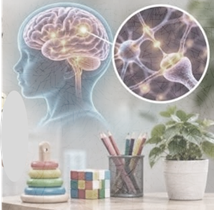
Neurodevelopmental disorders (NDDs) are conditions that begin in the developmental period of life and cause impairments in personal, social, academic, or occupational functioning. Signs appear in infancy, childhood, or adolescence (in some cases even into adulthood), though severity and support needs vary widely from mild to severe.
Causes may be related to brain development, genetic mutations, maternal infections/exposure to harmful substances during pregnancy, birth injury or complications, prematurity or low birth weight, or early childhood brain injury or illness. However, in many cases, an exact cause cannot be identified.
TYPES OF NDDs
The two primary diagnostic systems, the DSM-5 (Diagnostic and Statistical Manual – American Psychiatric Association) and ICD-11 (International Classification of Diseases- World Health Organization), classify them into the groups below.
Autism Spectrum Disorder (ASD)
Often referred to as autism, affects how a person communicates, interacts socially, learns, and processes sensory information. It is called a “spectrum” because traits, strengths, and support needs vary widely from person to person. Specialists (such as developmental pediatricians, psychologists, or psychiatrists) evaluate developmental history, communication, and behavior.
Clinicians no longer diagnose types of autism and instead describe support needs across three levels—from needing support (Level 1) to requiring very substantial support (Level 3)—tailored to each individual. Key features are-
- Social communication and interaction: Differences in eye contact, facial expressions, gestures, back-and-forth conversation, or reading social cues and non-literal language.
- Repetitive behaviors and focused interests: Repetitive movements or speech, strong preference for routines or predictability, intense focus on specific interests, and sensory sensitivities (such as to noise, light, or texture).
- Everyday impact: Support needs range from minimal day-to-day assistance to lifelong care, and co-occurring conditions like ADHD, anxiety, or sleep and digestive issues are common.
Attention-Deficit/Hyperactivity Disorder (ADHD)
ADHD is marked by patterns of inattention, hyperactivity, and impulsivity that interfere with daily functioning or development. The defining criteria are that symptoms last at least 6 months, start before age 12, and impair functioning in two or more settings. Young children often show obvious physical restlessness and impulsivity, while older teens and adults more commonly experience internal restlessness, procrastination, time-management struggles, and low frustration tolerance. Ongoing symptoms can affect school or work performance, relationships, self-esteem, finances, sleep, and safety (such as higher accident or risky-behavior rates); therefore, early detection and support are vital.
ADHD symptoms generally fall into two core groups:
- Predominantly Inattention: Trouble sustaining focus or finishing tasks, forgetfulness, losing items often, disorganization, daydreaming, and difficulty following instructions.
- Predominantly Hyperactivity and Impulsivity: Fidgeting or squirming, trouble sitting still or playing quietly, excessive talking, interrupting others, blurting answers, and acting hastily without thinking through consequences.
- Combined: Meets criteria for both inattentive and hyperactive-impulsive symptoms.
A qualified clinician, such as a psychiatrist, psychologist, or pediatrician, makes a clinical diagnosis by reviewing developmental and medical history, reports from different settings (like home and school or work), ruling out other conditions like sleep problems, thyroid disorder, anxiety, or learning disabilities, and checking for co-occurring conditions. Standard care often combines behavioral therapy or skills coaching (such as parent training, school accommodations, or cognitive behavioral therapy) with prescribed medicines, alongside consistent sleep, exercise, and routines.
Medicines prescribed may be:
- Stimulants (more common) that include methylphenidate and amphetamine-based drugs (available in short-acting and extended-release forms). They often work quickly to improve focus and impulse control. Side effects include decreased appetite or weight loss, trouble sleeping, irritability, headaches, or mild increases in heart rate and blood pressure. May occur. Doctors typically start at a low dose and adjust it gradually to balance symptom relief with side effects, with regular monitoring.
- Non-stimulants such as atomoxetine, guanfacine, clonidine, and viloxazine take longer to build up to full effect, can last up to 24 hours, and are often used if stimulants cause side effects or are not suitable or effective
- Medicines may be added for coexisting anxiety or depression.
Intellectual Disability (Intellectual Developmental Disorder)
Its main manifestation is significant limits in intellectual functioning and adaptive behavior. This includes challenges with reasoning, problem-solving, planning, abstract thinking, judgment, and learning from school or experience. There are also difficulties with everyday practical life skills such as reading, money management, communication, social judgment, personal hygiene, or household tasks.
Communication Disorder
These are conditions that affect a person’s ability to receive, send, process, and understand verbal, nonverbal, or graphic symbol systems. They present with delayed speech or language milestones compared with peers. These can range from mild sound substitutions to severe difficulties understanding or expressing language. The main types are:
- Speech disorders: Problems producing speech sounds or controlling the voice and flow of speech. This includes articulation problems, mispronouncing or substituting sounds, lack of fluency, stuttering or cluttering, issues with voice pitch, volume, or quality, and in some cases, coexisting motor speech conditions.
- Language disorders: Difficulty learning, understanding (receptive), or using (expressive) spoken, written, or sign language, including impaired vocabulary, grammar, and sentence structure.
- Social or pragmatic communication disorder: Trouble using verbal and nonverbal communication appropriately in social settings, such as taking turns in or maintaining conversation, participating in group interactions, adjusting tone or style to the listener, or reading social cues and body language.
- Hearing and auditory processing disorders: Challenges detecting sound or processing and interpreting spoken information, asking for repetition, speaking louder than usual, or struggling to hear speech in noisy places.
- Cognitive-communication disorders: Communication difficulties linked to thinking, attention, memory, organization, or problem-solving. (often following brain injury, stroke, or neurological decline or dementia)
Specific Learning Disorder (SLD)
SLD causes persistent difficulties in learning academic skills, specifically reading, writing, or math, despite normal or above-average intelligence and adequate instruction. Symptoms typically last at least six months and, unlike an intellectual disability, SLD affects targeted learning skills rather than overall cognitive ability. People with SLD often experience anxiety, low self-esteem, or co-occurring conditions such as ADHD.
Diagnosis involves standardized cognitive and academic testing by qualified professionals (such as clinical or educational psychologists), and management involves remedial teaching, school exam accommodations, and graded skill building. SLD is a diagnostic umbrella with specifiers for specific skill areas:
- Impairment in reading (often called dyslexia): Struggles with word accuracy, reading fluency, phonics/decoding, spelling, or reading comprehension.
- Impairment in written expression (often called dysgraphia): Difficulties with spelling, grammar, punctuation, organizing ideas on paper, or neat/effortless handwriting.
- Impairment in mathematics (often called dyscalculia): Challenges with number sense, memorizing math facts, calculations, or mathematical reasoning.
Coexisting conditions: Sometimes one or the above conditions may coexist in a patient, like ADHD with specific learning disabilities, or ASD with a communication disorder. Individuals may also experience epilepsy or seizure disorders, movement disorders, or mental health conditions like anxiety and depression.
Motor Disorders: These include coordination problems, stereotypic movement, and tic disorders (such as Tourette’s disorder) and are classified under neurological, rather than neurodevelopmental disorders, but in some cases can be present with the above NDDs
MANAGEMENT OF NDDs
A comprehensive clinical assessment, involving developmental pediatricians, neurologists, psychologists, speech or occupational therapists, and educators, is often needed to evaluate thinking skills, adaptive functioning, and potential underlying causes. A speech-language pathologist (SLP) and an audiologist (hearing specialist) may also be needed in certain cases. So, managing NDDs such as ASD, ADHD, intellectual disability, communication disorders, and specific learning disorders requires a personalized, multidisciplinary care plan focused on building skills, supporting daily functioning, and treating co-occurring symptoms.
Core Pillars of NDD Management
- Early and Behavioral Interventions: Early and ongoing interventions, such as special education, speech and occupational therapy, with life-skills and social-skills training, help individuals build independence and participate fully in daily life. Structured behavioral and developmental therapies such as applied behavior analysis (ABA), naturalistic developmental behavioral interventions, cognitive behavioral therapy (CBT), and parent training help build communication, social, and adaptive skills.
- Speech, Occupational and Educational Support: Speech and language therapy supports communication, while occupational therapy addresses sensory sensitivities and motor skills. Coordinating with schools ensures individualized learning accommodations and tailored instruction.
- Targeted Medicines: Medicines do not “cure” core NDDs, but help manage specific symptoms or co-occurring conditions, such as stimulants for ADHD, melatonin for sleep issues, or targeted medications for severe irritability, anxiety, depression, or seizures.
- Family Support and Medical Care: Ongoing monitoring of physical and mental health (such as gastrointestinal issues, epilepsy, anxiety, or depression) alongside caregiver support helps reduce family stress and improve long-term quality of life.
Also read:
Adult ADHD and Your Whole Health: Why It’s Often Missed, and What Helps