

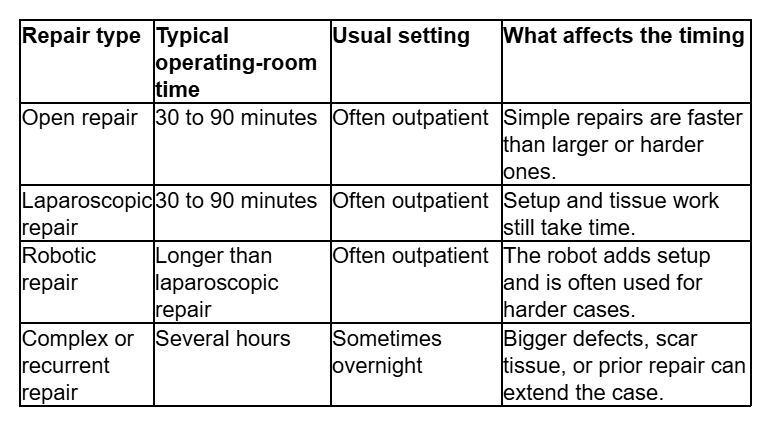
Hernia surgery usually takes about 30 to 90 minutes for many straightforward repairs, but complex cases can take hours. The exact hernia surgery time depends on the repair type, the hernia’s size and location, and whether the surgeon uses open, laparoscopic, or robotic repair. That matters because the operation is only part of the day.
How Long Hernia Surgery Usually Takes by Repair Type
A routine repair often fits inside an hour, while a complex case can take much longer. If you want a quick visual for what mesh support means, before-and-after hernia repair with mesh is the kind of comparison people usually have in mind.
What Makes One Repair Quick and Another Take Hours
The biggest drivers are the hernia and the repair method. A small first-time hernia with little scar tissue is usually quicker than a recurrent hernia or a large defect that needs more dissection and closure. Robotic repair can also add setup time.
- Size and location matter because harder-to-reach hernias take longer to expose and repair.
- Repeat repairs often take longer because scar tissue makes the operation less direct.
- Surgical approach changes the clock, with robotic cases often taking longer than open or standard laparoscopic repair.
- Mesh use supports the weak area, but placement still has to be done carefully.
Before You Go In, What the Day Actually Looks Like
You may be told not to eat or drink before anesthesia, and the team will review your medicines, especially blood thinners and anything that may affect bleeding. Depending on the case, anesthesia may be local, regional, or general.
Plan on needing a ride home even if the operation is short, because you may be sleepy or unsteady after anesthesia. That is one of the most common planning mistakes, and it is easy to avoid if you treat the appointment as a half-day commitment.
Recovery Clocks: First Day, First Week, and the Return to Normal Life
Recovery moves in stages. The first day is usually for rest, light walking, and watching for bleeding or severe pain. During the first week, soreness and swelling are common, but they should ease. By week two, many people move more comfortably, though lifting limits still matter.
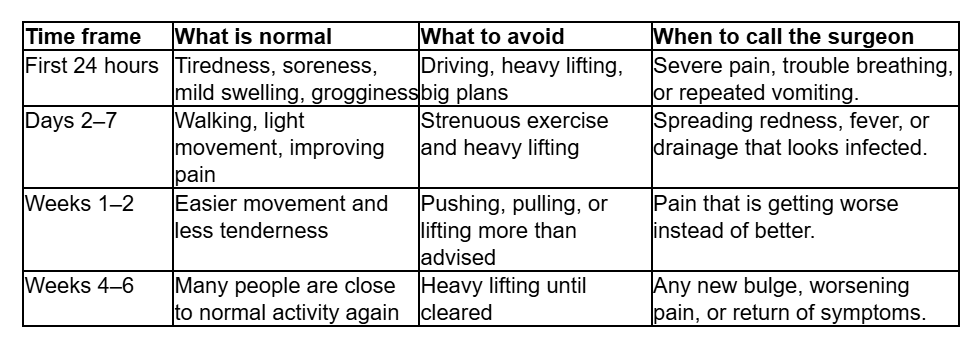
Desk work may restart in a few days if you feel well, but physical jobs usually take longer. If your job makes you brace, lift, or twist, expect a longer restriction than someone who sits at a desk.
When a Normal Recovery Is Not Normal
Some discomfort is expected, but a few symptoms should not be ignored. Worsening redness, fever, pus, shortness of breath, vomiting, trouble urinating, or pain that keeps getting worse can point to a complication instead of routine healing. Infection, bleeding, blood clot, or recurrence are uncommon, but they matter because early treatment works better than waiting.
Frequently Asked Questions
How long do you stay in the hospital after hernia surgery?
Most people go home the same day. That is common for uncomplicated open, laparoscopic, and many robotic repairs, although a harder case or a medical issue may mean an overnight stay.
Does laparoscopic hernia surgery take less time than open surgery?
Not necessarily. Laparoscopic repair can be quick, but the total time depends more on the hernia and the surgeon’s plan than on the incision style alone. Some laparoscopic cases are fast, and some open repairs are faster still.
Why does robotic hernia repair take longer?
Robotic repair often takes longer because the system needs setup and is usually chosen for more complex cases. That extra time can be worth it when the surgeon wants better control in a difficult repair.
How soon can I go back to work after hernia surgery?
Desk work may be possible within a few days, while physical work often needs several weeks. The safest guide is the nature of your job, not the surgery date alone, because lifting and twisting put more strain on the repair.
Conclusion
The useful rule is simple: plan for the operation to be short, but plan for the full day and the recovery to be longer. For a straightforward case, hernia surgery time is often under 90 minutes, yet the return to normal activity still takes weeks. Use your surgeon’s estimate, then build your schedule around the lifting limit, your job demands, and the signs healing is on track.
Also read: