

Defibrillators may be life-saving in the crucial minutes before the paramedics arrive if a member of the family or another person in the house has a cardiac arrest.
Automated external defibrillators (AEDs) assess whether a patient’s heart rhythm is suitable for defibrillation, and advise or deliver a shock when indicated, depending on the model. Many are small and light enough for laypeople to use, and will talk them through all aspects of managing the casualty.
Ease of access to the unit itself and to information on how to use it, plus ease of checking and resupplying, are all important considerations. So this article looks at a range of features of 4 different AEDs currently sold in the UK.
Inside This Comparison
- Home AEDs at a Glance
- Turtle Defib Cabinets: HeartHero Elliot, Best Overall for Home Use
- ZOLL Medical: Fully Automatic AED Plus, Best for CPR Feedback
- HeartSine: samaritan PAD 360P, Best for Cartridge Maintenance
- Philips: HeartStart HS1, Best for Step-by-Step Voice Guidance
- How to Choose a Home Defibrillator
- Home Defibrillator Questions
- Which Home AED Makes the Most Sense?
Home AEDs at a Glance
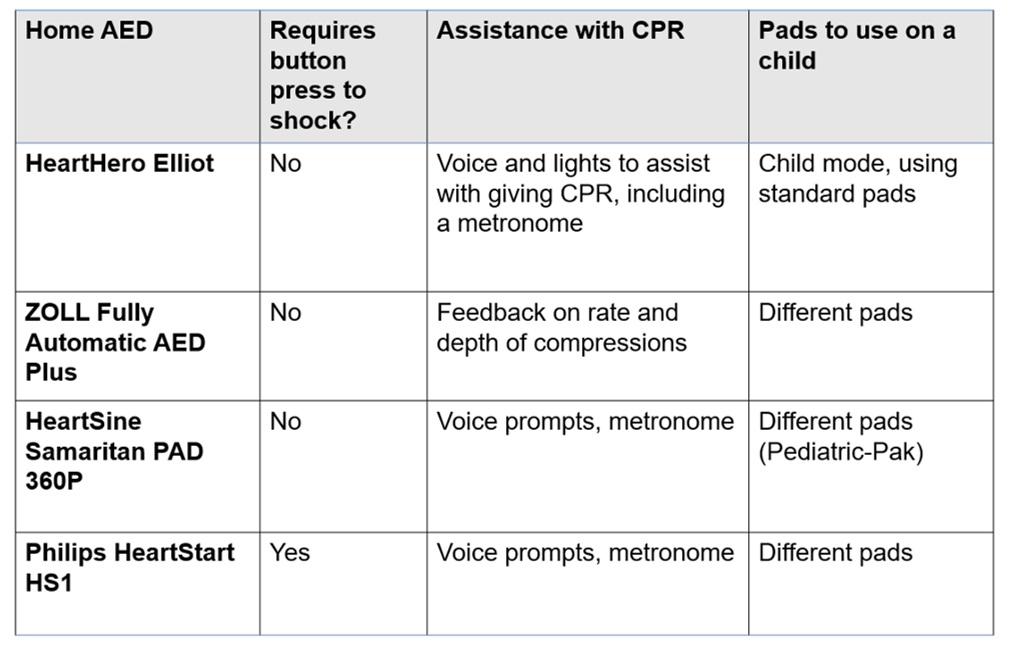
Fully automatic models deliver an indicated shock without the rescuer pressing a shock button. Semi-automatic models require the rescuer to press that button when instructed.
1. Turtle Defib Cabinets: HeartHero Elliot, Best Overall for Home Use
This appears to be a relatively new product available in the UK, and is CE-marked by the manufacturer. It has a very compact and light body, and is fully automatic.
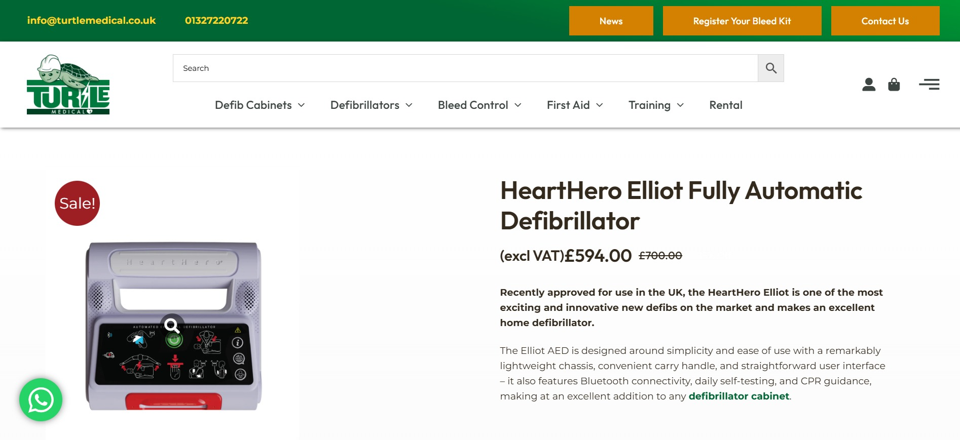
Including its batteries and pads, it only weighs 671 g, compared with, for example, 2.6 kg for the Powerheart G5, so it weighs less than a third as much, and its built-in carry handle makes it convenient to carry to the casualty, once taken from its cabinet.
The pads are readily available once the long red pull-handle is pulled, which also activates the unit. The advantage of this is that the pads remain in their safe seal until required, reducing risks en route to the casualty.
Features useful for a family situation:
- will defibrillate automatically once it has determined that it is appropriate, prompting the bystander to ensure nobody is touching the patient;
- voice and lights to direct an untrained user through each stage; a metronome to assist with rate of chest compressions;
- child mode, so no need for a separate set of pads, for eligible children, following the manufacturer’s age and weight instructions;
- can be linked via Bluetooth to an App to indicate general function, when servicing is required, and to allow updates;
- performs various checks each day to help detect faults and alerts users to problems via the AED display and, if applicable, the App.
Naturally, the App will only be of use in monitoring and maintaining the defibrillator, and would not play any role in an acute situation, which can be managed by following the various directions issued from the AED.
Like the other models reviewed here, the HeartHero Elliot defibrillator can be re-supplied with new batteries and pads, and there is a cover available to fit over the whole unit. On balance of its easy storage, simplicity of access to the various parts required, and re-supply, it seems an ideal candidate against which others would be judged.
2. ZOLL Medical: Fully Automatic AED Plus, Best for CPR Feedback
The ZOLL Fully Automatic AED Plus has a unique advantage in that it is able to comment on the depth of compressions applied during CPR, prompting increased effort if required.
As with the others, there are various verbal and visual prompts to assist the rescuer. Once it determines the rhythm to be shockable, it gives appropriate warnings before automatically applying a shock. So it has the advantages of being fully automatic while also providing useful additional information about effective CPR being applied to an adult casualty.
Obviously of most benefit if the user has had some training and practice in giving effective CPR. The unit is larger than an ultralight model, and, as noted above, the correct size pads should be available to use on a child.
3. HeartSine: Samaritan PAD 360P, Best for Cartridge Maintenance
The HeartSine Samaritan PAD 360P has the sensible approach of combining the batteries and pads to apply to an adult in a single Pad-Pak. So only one item to ensure is not past its usable life and to replace when necessary.
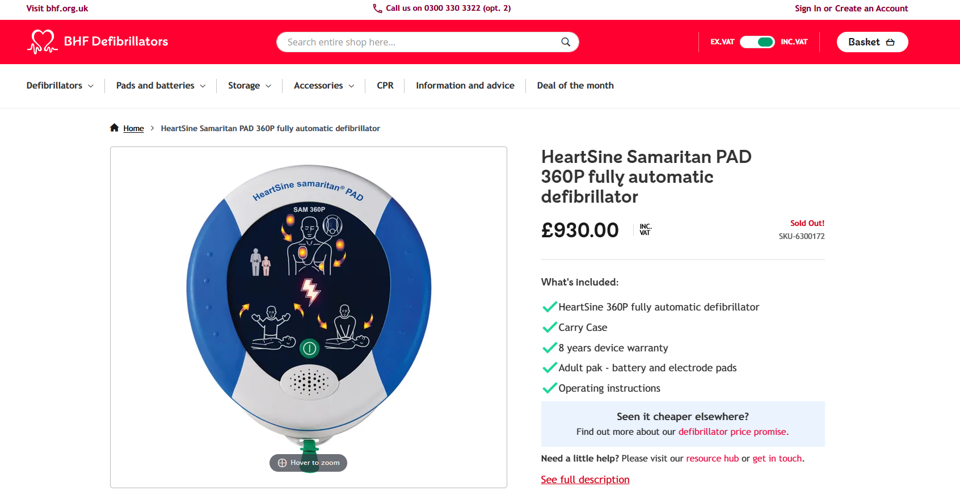
It weighs approximately 1.1 kg and gives voice instructions and metronome to aid with CPR, an indicator light showing general state, and performs tests weekly.
The downside, of course, of combining the battery and pads in one unit, is the need to keep a separate Pediatric-Pak available, as recommended by the manufacturer for use on some children.
The 360P is the subject of a current field safety notice. Current and prospective purchasers would be advised to check whether this is relevant to their particular model and act accordingly.
4. Philips: HeartStart HS1, Best for Step-by-Step Voice Guidance
The Philips HeartStart HS1 would appeal to a user who wished to be verbally directed as to each stage of management, at a rate appropriate to their progress.
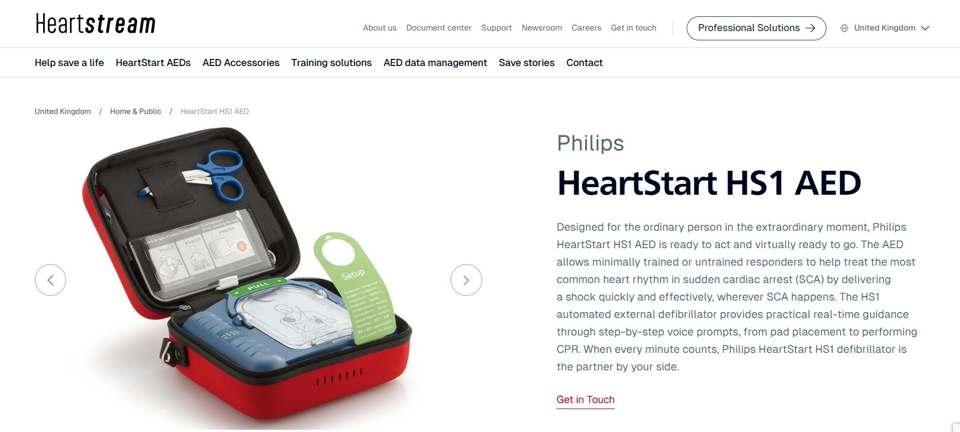
There are also various symbols displayed and a metronome to aid CPR. Once it has established whether a shock would benefit the patient, it directs them to apply this by pressing a button.
The manufacturer states that a variety of self-tests are performed routinely. To use on children, the appropriate SMART Pads should be used, altering the directions given and level of shock delivered.
So, an alternative for someone preferring detailed voice directions.
How to Choose a Home Defibrillator
Ideally it should be easily stored to be within the parameters laid down by each manufacturer, and be obvious where it is kept so as to be rapidly available to those residing there.
- Likely users- all children who may be living or visiting should therefore be taken into account re suitability of paediatric mode or availability of separate child-sized pads.
- Various aids to effective CPR can be offered, as outlined above; note the difference between a simple metronome to encourage an appropriate rhythm, and devices able to monitor and make comments on other aspects.
- What is involved in maintaining it in a fit state to use, that is, checking viability and date of any pads, battery changes, obvious displays, and ongoing costs.
Whichever model purchased, new or second-hand, ensure suitability for the UK and check MHRA field safety notices and any other relevant information from manufacturers. It would be prudent to seek advice on the desirability of having one in the house if any individual there is known to be at risk.
It would also be in keeping with the British Heart Foundation’s wishes to register an AED on The Circuit, even if not freely accessible to all.
Home Defibrillator Questions
Can someone without training use an AED?
Yes, that is the aim, of course, of producing them, but it is desirable to be trained and practised at giving good CPR. The current Resuscitation Council UK guidance would direct the bystander to telephone 999 as soon as they become aware of someone being unresponsive, start CPR if not breathing normally and use an AED when to hand, continuing to obey instructions given verbally by both.
Is a home AED a replacement for emergency medical care?
Obviously not, as there are many causes of a patient’s heart stopping and it will only shock if certain patterns are detected. It is a great aid in continuation of resuscitation but no substitute for skilled help.
Which Home AED Makes the Most Sense?
A suitable home AED should be one that can readily be maintained, readily located, and then used effectively to follow the instructions issued, would be suitable for a home situation, with others preferring the extra information on effective CPR or ease of changing pads and batteries. Overall though, the size and simplicity, including in respect of applying to children, of the Turtle Defib Cabinets’ HeartHero Elliot are attractive features if there are a number of potential users.
Also read: